
Expert Antique Trunk Restoration
Historic pieces receive careful restoration with remarkable craftsmanship.
Restoring a Cherished Family Heirloom

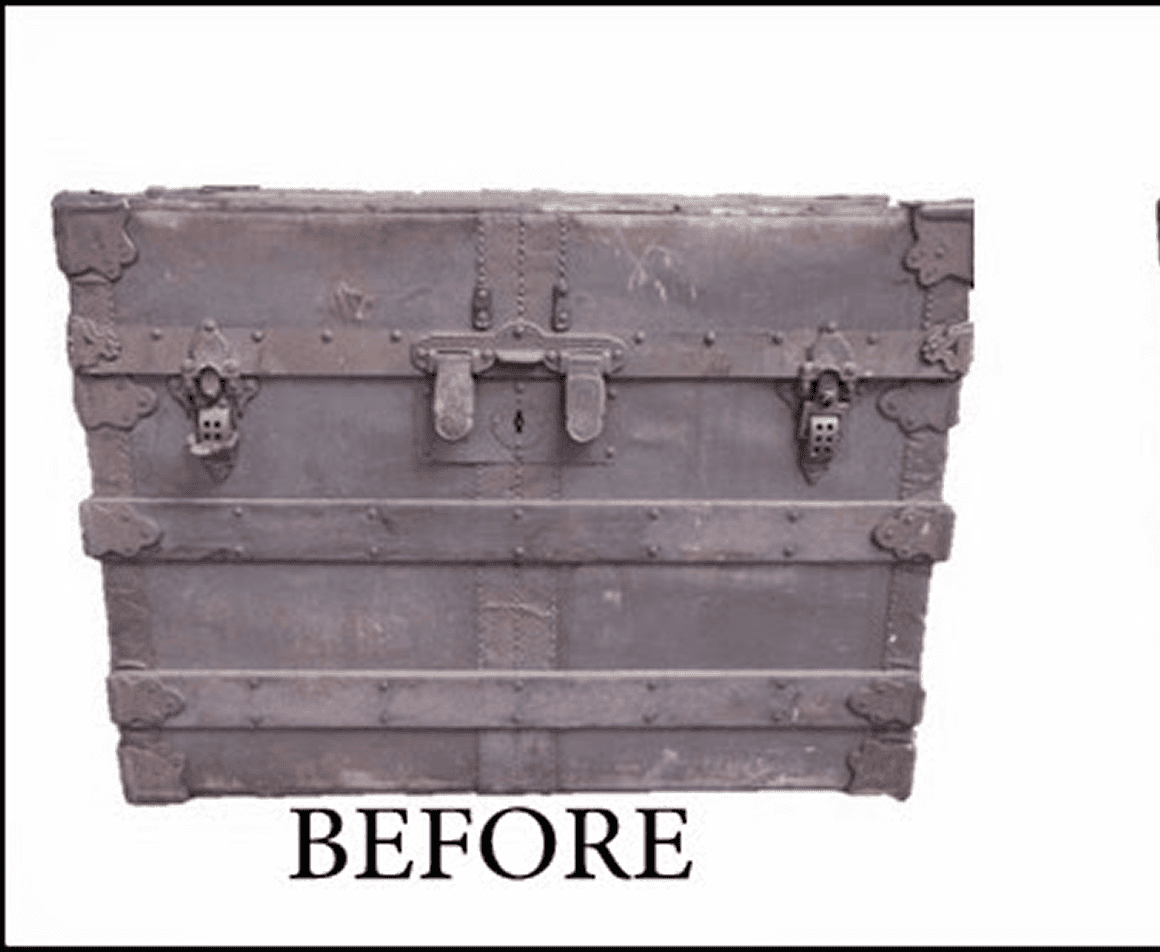
Have you been thinking about having that old trunk of yours restored, that maybe belonged to your parents, grandparents, or your great-grandparents? The one that has been in your garage all these years, continuing to collect more dirt by the day, worn out and colorless and just plain in the way because you keep moving it around, saying to yourself, “One day I’ll get that antique trunk restored…but not now.”
Things to Consider Before Restoring

Here are some points to consider…

Why Waiting Can Cause More Damage
If your trunk IS an heirloom, it unfortunately will be getting worse before it gets better if you just let it sit, not the best option. Although most antique trunks were built to take years of abuse, they do, just like anything else, deteriorate over time. Instead of it being an eyesore that only belongs in the garage, it probably has some real beauty underneath its age wear.
The Beauty Hidden Beneath the Surface
That’s the way trunks were built – to be used for travel and to NOT be an ugly monster once they arrived at their destination; they were made to be pretty. Beneath the dark exterior stains and years of grime, sweat, and toil, you have one of the finest pieces of furniture ever built, neglected now perhaps, but waiting to be reborn to a time of glory, when your relatives were proud of their wooden cases, which reflected their personalities in ways that we have all but forgotten now.
Bring Your Antique Trunk Back Home
So unless you are just utilizing that antique chest as a stepping stool to find what is in the boxes above it, or as a catch-all for old mementos that will sympathetically absorb the “old” in which they are stored, it might make sense to be able to use that trunk in a more productive way, IN your home, instead of on the outside.
A Functional Piece With Lasting Value
An antique trunk can provide a great deal of additional storage space within your home while still being a present and ongoing tribute to your family legacy. Looking for an amazing coffee table? There is nothing better than an antique steamer trunk, a table with some real storage.
The Value of Trunk Restoration
Understanding the Value of Restoration
OK, so now you think it’s probably a good idea to have the vintage trunk refinished and finally bring it into your home. "But what about the value of my antique trunk after it has been restored? Will it be less valuable? More valuable? Will I be able to get more money for it if I restore it?" Take a minute to read the paragraph below. It will answer a lot of your questions, many of which are posed to us each day.
An Expert Perspective on Restoration Value
We found this article on a website that dealt with antique trunks years ago, and if you have concerns over how the value of your trunk might be affected by a restoration, this article says it better than we could have.
“Much controversy exists over "restored" or "original" in relation to a trunk's value. However, little information exists regarding what actually determines the value of a trunk or even a proper definition of the term "value" as it is applied in this situation.
What Increases an Antique Trunk's Value
For the largest percentage of trunks, an increase in monetary value is bestowed upon those with visual appeal, exceptional condition, unique attributes such as rare design, or from a maker whose works are collected. Often, it matters little either way whether these examples are restored or original, as the value is determined on a case-by-case basis by the individual buyer. However, there are trunks that exist whose value is measured not only in monetary terms but, more importantly, in historical value.
When History Matters Most
This is the heart of the debate and the only real argument that exists in trunk restoration. To take an essentially ruined standard trunk with not one shred of evidence regarding its past and restore it to a nice, usable antique piece generally makes it more appealing and increases its market value over its original state.
Balancing Restoration and Historical Significance
However, restoring a trunk with a link to an important historical person or event could destroy any proof of its past, in which case history is lost, and the monetary value would be significantly reduced. As it turns out, situations exist where both sides are correct. A well-done restoration or refinish can increase a trunk's value.
Every Trunk Requires Individual Consideration
Conversely, that same restoration can destroy important information regarding a trunk's history, and its original condition would have been the more valuable state in all aspects. This debate is not unique to trunks and is frequently applied to most antiques in general.
The Importance of Proper Evaluation
Often, the most important skill is in understanding the significance and uniqueness of the particular trunk in question. Some are simply very rare, while others could be called historically significant.
The Right Way to Begin Restoration
A proper restoration should begin with understanding the type of trunk in question and researching information regarding the history of the trunk if present. If in doubt, it is best to approach conservatively.
Experience Makes the Difference
Nearly all the hundreds of professional and part-time restorers in the United States have their preferred or learned method of restoration. However, there are only a few who are able to gain the experience necessary to master more than two proper techniques.”

A Lifelong Passion for Restoration
So how does this all happen? Learning how to restore an antique trunk is a lifelong mission, and this is our dedication. As much as we might be told that it's a "crazy niche" we're in, we wouldn't want to be anywhere else or doing anything else.
Review of a Restoration
"We just received my EXPERTLY restored trunk. I am sure that if my grandfather were still alive, he would love your work! Thank you so much for performing an EXCELLENT restoration!!!"
Rich H. Portland, OR.
Why Restoring an Antique Trunk is Worth It
Great idea to get these restored! Here’s why:
Customization Tailored to Your Style
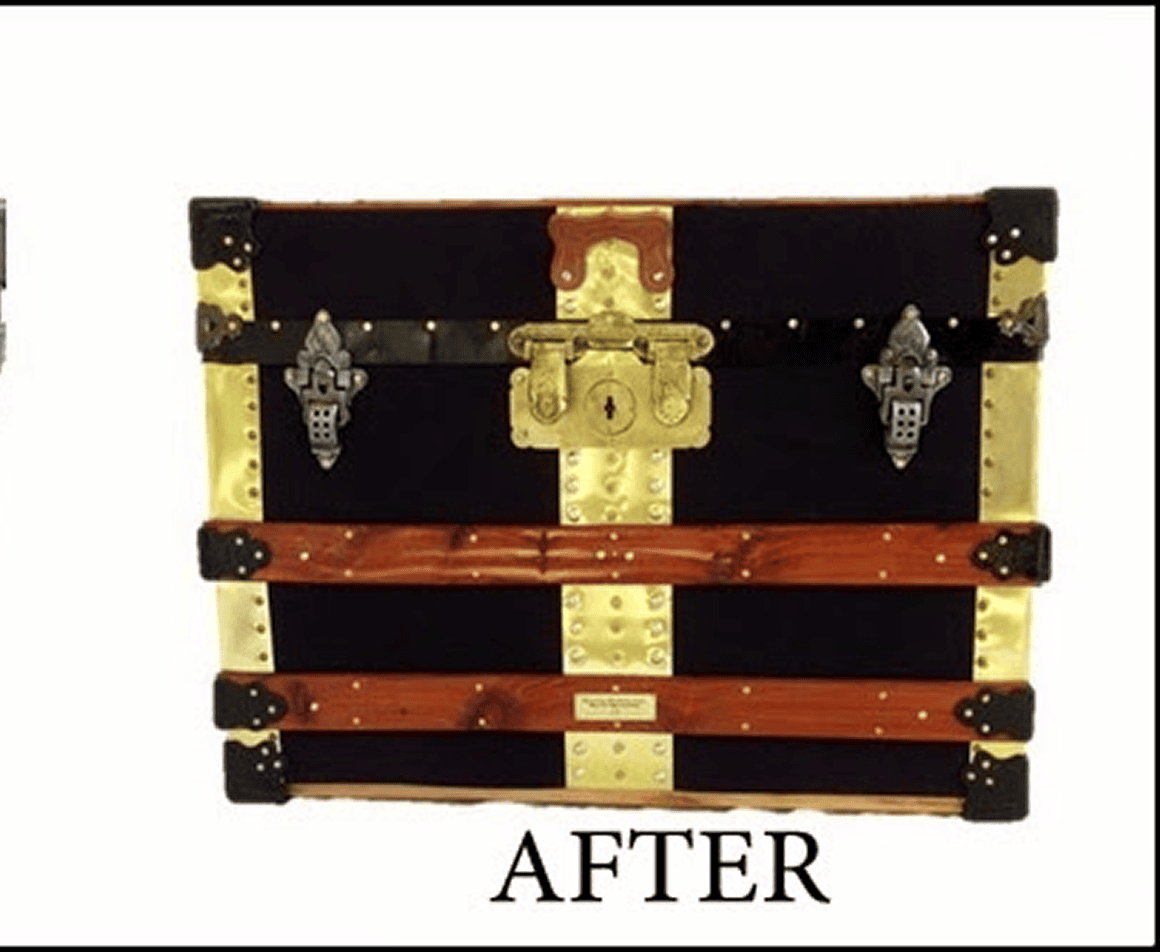
Want a more modern feel for your trunk while having it remain true to its historical background? We can recover exteriors in fabrics or colors of your choosing, or remove present coverings and refinish the wood underneath for a more rustic look and feel. It's up to you.

Customer Story
"I was amazed by the work that Randall Barbera did and did not think such work was possible. ASTOUNDING!" Brian Kenny - Director of Collections and Archives/THE HEARST CORPORATION.
Every Restoration Starts With a Conversation
This is why it is important that we speak before starting any antique trunk restoration project. The word “restore” means many things to many different people, and, because it is YOUR antique trunk, it should suit your specific vision when complete.
Bringing Your Vision to Life
We once had a client who wanted us to paint his trunk ORANGE! That's right, orange! So what did we do? Why we did, in fact, do as they wished, and, believe it or not, once the project was completed, his antique trunk looked pretty ridiculous. When we sent him a picture of his steamer trunk, he then asked us to strip down the paint to the wood (which we did) and then refinish the trunk with natural stains and varnishes.
Words by the Customer
"Started to restore a trunk used by my wife's grandmother when she came to the US in 1902. The trunk was in bad shape, but it was important to us. I was out of my league in the restoration process, so I shipped it to California. Glad I did! The job that was done on it was wonderful. It is now a family heirloom. We couldn't be happier. Great restoration, and we owe a debt of gratitude to the folks at Antique Trunk Restoration & Design for a beautiful job well done!"
Phil E. BURGETTSTOWN, PA
Commentary: “Antiques Roadshow” and Refinishers by Peter Cook
Peter B. Cook, executive producer of Antiques Roadshow, has been a writer and producer at WGBH Boston for 32 years. His award-winning credits include The Advocates (1970-74), Arabs and Israelis (1975), and Concealed Enemies, winner of the national Emmy for Best Limited Series in 1984. He also made a few trestle tables back when 5/4 by 18 clear pine was $1.25 a foot.
"Antiques Roadshow generally agrees with this notion: well-conceived and well-executed refinishing and restoration usually enhance the value of just about any piece of old furniture".
A while ago, we at Antiques Roadshow received a letter from Professional Refinishing editor Bob Flexner, pointing out that our apparent obsession (my word, not his) with "original finish" has had the effect of misleading the public about what repairing and refinishing actually do to the value of furniture - most furniture, that is.
We're now in our sixth season of Antiques Roadshow on PBS, and many millions tune in every week. No other PBS program attracts such numbers week after week, year after year, and if our audience enjoys the entertainment value of the show, they seem to appreciate the information they glean at least as much. This means, of course, that there's a real premium on the accuracy, dependability, and usefulness of the information we provide. Professional Refinishing contributor Larry Sullivan wrote in a May 2000 Commentary that, while it was fair enough to point out that for very old, very valuable, museum-quality furniture, "a refinished piece has less value than a piece in pristine original condition ... But the Roadshow reaches millions of people who almost never see this type of furniture other than in museums."
The roadshow further misleads people, Larry contended, because when the appraisers talk about value lost because of refinishing, they don't make the point that they're only talking about certain rare pieces. And they usually don't make the point that anything repaired and/or refinished was probably in pretty poor shape to begin with. The unfortunate result is that more and more people are afraid to have their dilapidated furniture touched. "They're even afraid to have minor damage repaired for fear of making a serious financial mistake." After noting that most people shouldn't have to worry about market value and "should be allowed to feel comfortable in having their furniture refinished and restored in a manner that pleases them," Larry closes by urging experts on the Roadshow to "play a key role in properly educating the public." While emphasizing the value and beauty of an original finish in good condition, they should also advise the public that most furniture does not lose value when refinished and that, in fact, this furniture should get a new finish when the old one loses its visual and protective qualities."
These are very good points. I'd hate to think that we've created a subset of American furniture owners living in dread of a fatal financial misstep (though Antiques Roadshow is, after all, about value, including market value). We do have many people on the show - probably the majority - who have no intention of selling their pieces, and they are routinely encouraged to enjoy and use their antiques. On occasion, we also go into some detail on issues of restoration and conservation. Still, if I'm reading this thing correctly, it sounds as if the Roadshow furniture experts are always saying, by and large, "Leaving things alone is good; refinishing is bad." Understandably, our Americana experts on the Roadshow live for wonderful old pieces of furniture that have somehow survived in terrific condition - pieces not used too hard, left out in strong light for long periods of time, or forced to survive a flooded cellar. Most old furniture, of course, doesn't come close to meeting those standards. On the contrary, most furniture has been well used (even abused), scratched, broken, and often repaired many times. How could such furniture not be improved by a good job of refinishing or restoring? I talked with some of our furniture specialists, and it's fair to say that I found more agreement than I expected on this issue. Stephen Fletcher of Skinner, Inc., told me that more and more people are now "smart enough" to ask about a given piece: "Is this something I shouldn't touch, or does it matter?" Others in our cadre of furniture regulars said more or less the same thing.
As an example, a great old secretary (bookcase on chest) made in about 1820 by Christian Shively came into our Indianapolis event this year. It had come to the current owner covered with 80- to 100-year-old paint, and she'd had the piece completely refinished. John Hays, the Americana specialist from Christie's, said, "You had no choice," and went on to compliment the refinishing work and state the obvious: that the restoration had saved the piece and created substantial value where there had been virtually none.
To be sure, this is just one instance held up against many others on the show that glorify an original finish, and it's true that we don't include very much "ordinary" furniture. We're planning a segment in a future roadshow, however, involving three pieces of furniture: one that shouldn't be touched, one where it wouldn't make any difference what was done to it, and one somewhere in the middle.
The question of what to do when a piece isn't quite perfect arises just about everywhere we go. At the Antiques Roadshow stop in New York City, Leigh Keno came across a classic, circa-1765 Philadelphia candlestick he said was in beautiful "original" condition - except for a "new" finish that someone had applied to the top about a century ago and that was badly alligatored. Even with this defect, let's call it, Leigh thought the table would bring something like $150,000 in today's market.
Leigh asked the table's owner whether she was disposed to fix the top. She replied that she'd rather leave it alone, and Leigh agreed, "That's probably what I would do." Well, having heard from Professional Refinishing last year, we wanted to press Leigh on that point, so we asked him why this table wasn't a perfect candidate for a good, professional attack aimed at restoring something close to the coveted original finish. Wouldn't that both improve the aesthetic qualities of the piece and enhance its value?
The answer, Leigh said, was that many high-end collectors - his customers - wouldn't mind the addition of the second finish and that the old look of the craquelure might even be appealing to some. Trying to remove the added finish to reveal the original underneath is easier said than done: the original finish might not even be there, and refinishing would likely make the piece look too new.
So where does that leave us? Let the record show that Antiques Roadshow generally agrees with this notion: well-conceived and well-executed refinishing and restoration usually enhance the value of just about any piece of old furniture. Exceptions are those rare (often museum-quality) pieces that have somehow survived in great `original' condition. If we say or imply the contrary, we should be called on it.
I thank Professional Refinishing for the chance to address the issue here, and I hope many professionals in the refinishing business will let us know from time to time what they think.
Enhance Your Antique Trunk
So do you want to start enjoying, instead of storing, your antique trunk?
Getting Started Is Easy
Here’s how
1
Take pictures of your trunk, inside and out, so that we can see its condition.
2
EMAIL the pictures to us at info@randallbarbera.com, and make sure to include your phone number and best time to call you.
3
We’ll review the photos, and then, within a few hours, we will call you to discuss:
- What would you like the trunk to look like once restored.
- Best ways to pack and ship your trunk (and some great tips to save money in doing so!)
- Turnaround time: How long it will take for us to complete the job.
- Price estimate: How much will this cost to complete?
Ship Your Trunk With Confidence
The next step will be to ship your trunk to our shop (we’ll talk about it all in step #3), and once it arrives, we will make sure you know that it is resting in our shop, waiting its turn to be restored, the way you want it!